
India’s Food Security Illusion
A short piece on India’s Food Security impacted due to West Asia crisis

Agriculture was always a comfortable assumption in my head. My school textbooks told me that 50% of India’s population depends on agriculture and allied activities and 70% of rural population. That number felt like a guarantee , if nearly half the country farms, surely we feed ourselves. With the advent of smartphones, social media, and AI, I worried we were falling behind in technology. But food? That, I assumed, we had covered.
The truth is far from what’s known.
India houses 1.4 billion people one in every eight humans on Earth on a landmass that is 2.4% of the world’s surface. For context, rural Indians spend 47% of their total household income on food. Urban Indians spend 40%. Before Wi-Fi, before EVs, before semiconductors — there is food. And food, in modern agriculture, means fertiliser.
So let’s ask a simple question: is India actually self-reliant in fertiliser?
Google it and you get reassuring numbers. India produces 80% of its urea consumption domestically. It produces 40% of its DAP requirement. Fair enough, you think. Not perfect, but not bad.
Except those numbers hide more than they reveal.
The “Made in India” problem
In India, if a product is assembled or finished here, it is counted as domestically produced regardless of where the ingredients come from. This is not unique to India, but in fertiliser it creates a dangerous illusion.
Take urea. India has 33 urea plants. They produced about 30.7 million metric tonnes in 2024-25. Impressive. But 85% of those plants run on imported natural gas mostly from the Gulf, transiting through the Strait of Hormuz. Natural gas accounts for nearly 90% of urea’s production cost. The factories are Indian. The fuel that runs them is not. India’s urea supply chain is, at its foundation, a Gulf gas supply chain wearing Indian clothes.
A natural question arises if India produces 50% of its own natural gas, why do urea plants run on 85% imported gas? The answer is geography. India’s domestic gas fields sit offshore in the Krishna-Godavari basin and the Mumbai coast. Its urea plants sit inland —in Uttar Pradesh, Punjab, Rajasthan, Bihar. The pipeline grid connecting the two was never fully built. So imported LNG, arriving at coastal terminals and reliably piped inland, ends up feeding the plants, while domestic gas gets consumed closer to shore by refineries and city gas networks. India produces gas. It just cannot get it to the right place.Domestic gas is limited and is allocated across sectors, with rising demand from city gas networks and households

Now take DAP, the second most widely used fertiliser. India claims to produce 40% of its consumption domestically. But DAP is made from phosphate rock 90% of which is imported from Morocco, Jordan, and Egypt. It also requires sulphur, a byproduct of Gulf oil refineries, whose supply chains have already been disrupted by the ongoing West Asia conflict. And it requires ammonia and in 2024, India and the United States were the world’s two largest ammonia importers. 9% Rupee depreciation in 1Y is making worse.
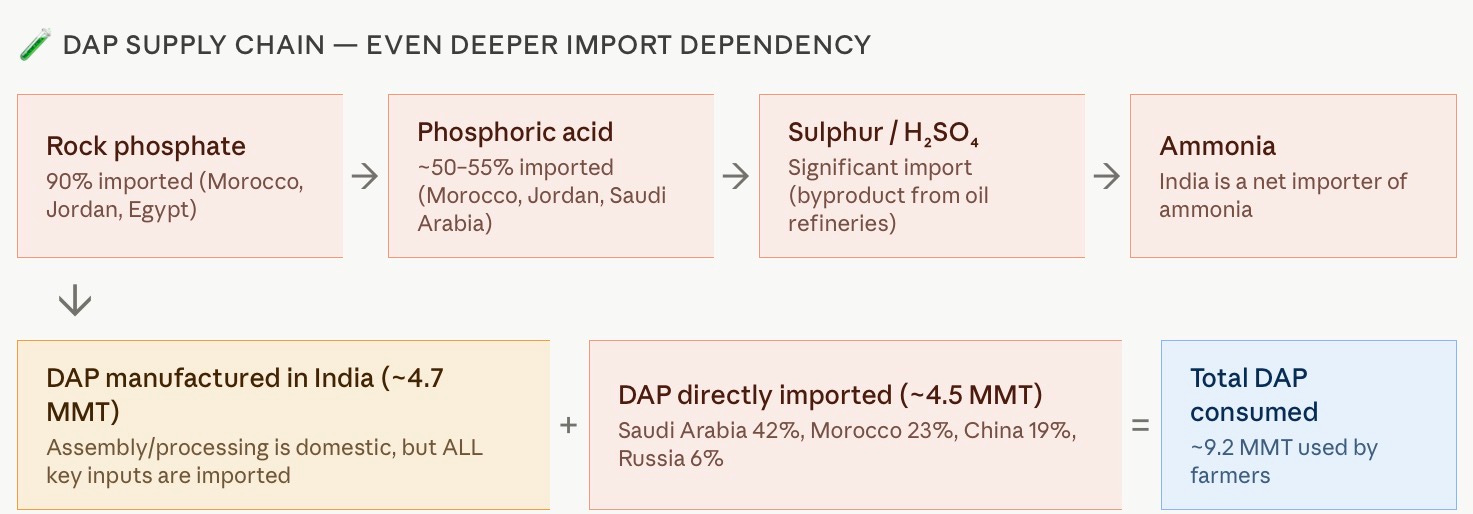
As for potash and phosphate fertilisers — 100% imported. No domestic production. No reserves worth speaking of.
Why does India manufacture at all then?
Because it is cheaper to import the parts than the finished bag. By converting imported gas into urea on Indian soil, India captures a small manufacturing margin — jobs, some plant activity, some GDP. It also gives the government price control over urea, which has been fixed at Rs 270/50kg. If India imported finished bags, that control would evaporate overnight.
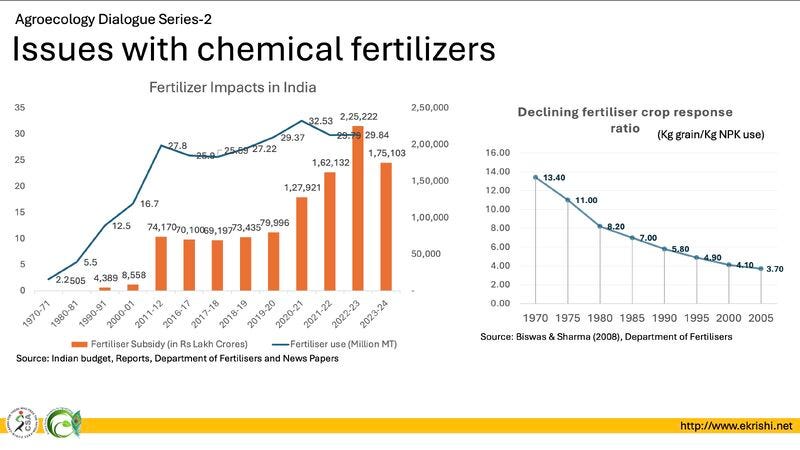
The economics make sense at normal gas prices. But when global LNG prices spiked after the Ukraine war in 2022, India’s fertiliser subsidy bill crossed ₹2.5 lakh crore in a single year because we kept running plants on expensive imported gas rather than importing cheaper finished product. The “manufacturing” was costing more than simply buying the bag.
What this actually means
The West Asia conflict is not just a geopolitical story. It is a food security story for India. A disruption to Gulf gas supplies does not just raise energy bills — it threatens the feedstock for urea plants. A disruption to Moroccan phosphate exports does not just affect one commodity, it directly hits DAP production. India’s food supply chain has a single point of failure, and that failure point sits thousands of kilometres away in a region currently at war.
I will resist the temptation to go further into how 36% of India’s fertiliser subsidy leaks out through smuggling to Nepal and Bangladesh, into how soil health is collapsing from decades of urea overuse, into how crop yields are stagnating despite rising fertiliser consumption. Each of those deserves its own piece.
The point of this article is simpler: the next time you read that India is self-sufficient in fertiliser, remember what that sentence actually means. The factories are here. Almost everything that goes into them is not.
India spends less than 1% of GDP on R&D. We have not invested seriously in alternatives green ammonia, nano-urea at scale, domestic phosphate exploration, or reducing fertiliser dependence through precision agriculture. The solutions exist. Other countries are already building them.
The first step is to stop pretending the problem doesn’t exist. Acknowledge it. The crisis is not hypothetical. It is one prolonged conflict away.
The crisis is not hypothetical. We have solved harder problems. We have simply chosen not to solve this one.
How many kharif seasons does India have before the shelves thin out?
Great write up. Guess this is a story that plays out in most sectors.
Didn’t know how Made in India classification is made. Interesting!